

In enterprise technology, there’s a rhythm to how language evolves.
A new term surfaces at conferences. Analysts begin using it, earnings calls repeat it, and suddenly, every IT solution provider is “AI-native, composable, autonomous, and agentic.” The internal pressure mounts quickly as executive teams want to talk about innovation, boards demand alignment with the future, and sales need messaging that feels current and competitive.
This phenomenon is so common that Gartner built a practice around it: the Hype Cycle. This service helps organizations separate marketing hype from real technology potential, guiding investment decisions and reducing the risk of chasing every new trend and buzzword.
Ignoring the Hype Cycle can turn teams into trend-chasers. Resources are spent on immature technologies, opportunities are missed, and marketing is asked to rewrite the website (yet again).
The battle of the buzzwords
Writing a corporate website from top to bottom is one of the most overwhelming, time-consuming, sometimes life-consuming projects a marketing team can tackle. (Ask me how I know?)
A little over a year ago, a client took on a significant challenge: boosting its organic search rankings and increasing visibility on search engine results pages (SERPs). To tackle it, they made a bold choice: completely overhauling the website from the ground up.
With over 130 pages planned, the project took nearly a year to complete. By the time it was finished, the total content length rivaled that of The Grapes of Wrath (about 170,000 words for both). While that might sound daunting, the real pain was contending with new buzzwords that kept popping up throughout that year, leaving us to play a terrifying game of keyword whack-a-mole in the middle of content development. Miraculously, the site launched, we met the goal, and SEO metrics increased dramatically.
Also read: Agentic AI Is Not a Channel Marketing Strategy
Search terminology
Most technology buyers do not begin their buying journey with jargon. They begin with established terminology.
They search using practical, established terms tied to real problems and known solutions. They look for the phrases that procurement recognizes and technical teams understand. Buyers are more likely to search for “enterprise data integration platform” than “AI-powered composable orchestration fabric.” While the buzzwords may sound fashion-forward, buyers aren’t buying trends. They are simply hunting down a proven solution.
The Hype Cycle
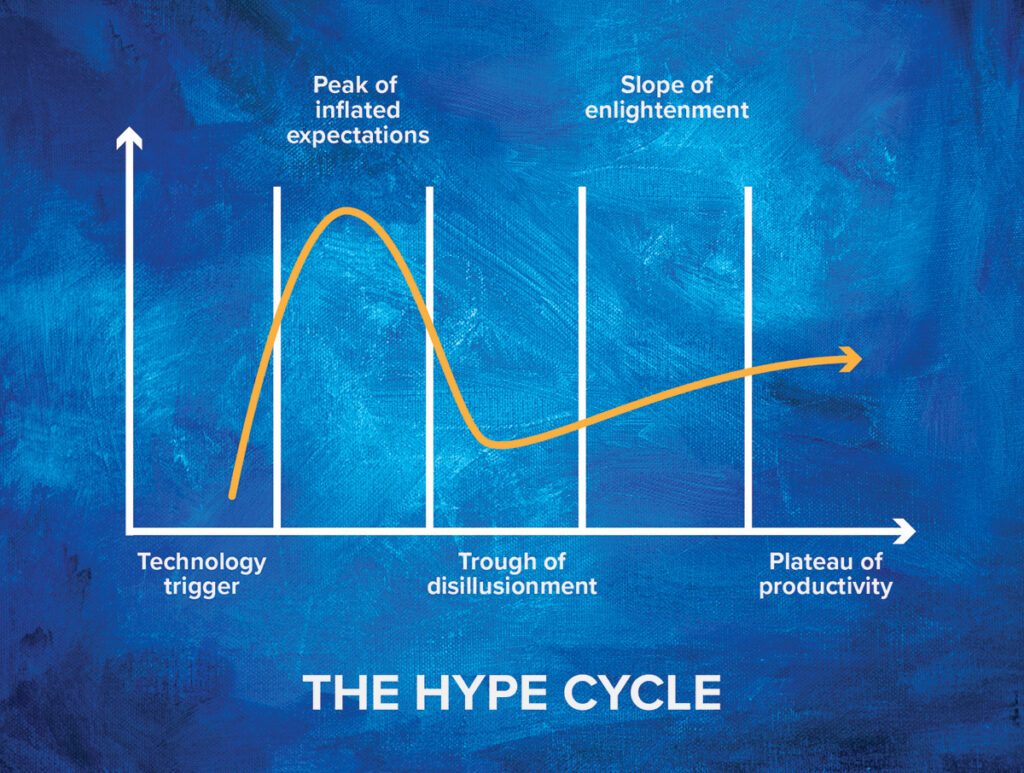
Gartner identified the consistent behavior in trend-driven language and aptly named it the Hype Cycle. Buzzwords don’t just trend; they follow a pattern.
- It starts with an Innovation Trigger. Something new gets introduced at a conference or in an analyst report, and curiosity spreads.
- Then it hits the Peak of Inflated Expectations. Your CEO has heard the term. Now it’s in every deck, on the homepage, and the topic of every blog. Marketing starts moving faster than technology.
- After that comes the Trough of Disillusionment, aka the hangover. Adoption is slower than anyone promised. Teams start asking whether any of this actually works. The language starts to fragment.
- Things stabilize on the Slope of Enlightenment. Organizations figure out what the thing actually does, and the marketing terms settle down with it.
- Eventually, you hit the Plateau of Productivity. The early buzzwords are gone. What’s left are the terms buyers actually use when they’re ready to buy.
This is why content teams feel whiplash every quarter. “AI-native.” “Autonomous orchestration.” The hype is loud, and these phrases peak before most companies have figured out what they mean, let alone adopted them.
You’re writing for more than search engines now
Beyond the Hype Cycle, there’s another shift happening beneath the surface.
Enterprise tech buyers are increasingly turning to AI tools to do their vendor research. They’re using AI as a search engine to get quick comparisons across all tech companies before they ever visit your website.
Here’s what that means: AI systems retrieve and synthesize information by looking for patterns. They gravitate toward clear definitions, consistent terminology, and content that explicitly connects a problem to a solution. What they don’t reward is marketing hype.
So if you rename your services every 18 months to chase the latest trend, you’re not just confusing buyers, you’re making it harder for AI to find you. Not because your solutions aren’t valuable, but because the consistency these search systems rely on to find you just isn’t there.
Also read: GEO vs SEO: How to Show Up in AI Searches
Separate discovery from positioning
The companies that manage innovation well operate with two layers of content.
The first is discovery content, which includes product pages, case studies, whitepapers, and FAQs. They should use plain, stable, category-aligned language because that’s what search engines index and AI looks for.
The second is positioning content: your homepage hero, executive thought leadership, and trend-driven blogs. This arena is where you can talk about AI-native architectures, autonomous workflows, and whatever the current catchphrase is for “we’re ahead of the curve.”
Both layers have a job. The problem is that when teams let them merge, you end up with a site that sounds exciting but doesn’t rank, or worse, ranks for terms nobody’s searching for yet (and may never search for in any real volume, depending on how quickly a trend moves through the Hype Cycle or drops off completely).
The leadership conversation that needs to happen
When the push to modernize messaging comes from leadership, it’s easy for the discussion to become reactive. “We need to align with where the market is going.” That instinct isn’t wrong; innovation matters. But reacting by discarding stable marketing language isn’t the answer either.
The conversation needs to shift. Instead of framing the issue as a conflict with SEO, look at it as an opportunity to evolve positioning without sacrificing discoverability. Layer forward-looking language on top of a stable foundation. This strategy allows you to be future-forward and AI-friendly, while protecting the content that drives inbound traffic, builds authority, and saves significant time and budget that would otherwise be spent on endless rewrites.
Riding the Hype wave: How this works in practice
Here is a concrete example of how this played out over several years and through the Hype Cycle of a specific technology: SASE. Secure access service edge (SASE, pronounced “sassy”) is a networking technology that emerged in 2019. The technology combines several older networking technologies with cloud-enhanced security and features.
When we first started writing about SASE for a client, the related keywords hardly ranked. Fortunately, SASE was built on SD-WAN, a well-established networking technology. At first, our content was driven by think pieces that compared the two and outlined the benefits of switching.
As SASE entered the next phase of the Hype Cycle, Inflated Expectations, SASE keywords suddenly became very competitive. Our original content got a boost, but we needed to get creative with our keywords to stay competitive. By tying in numerous blog posts to related cybersecurity and networking topics, we rode the wave through the Trough of Disillusionment and the Slope of Enlightenment.
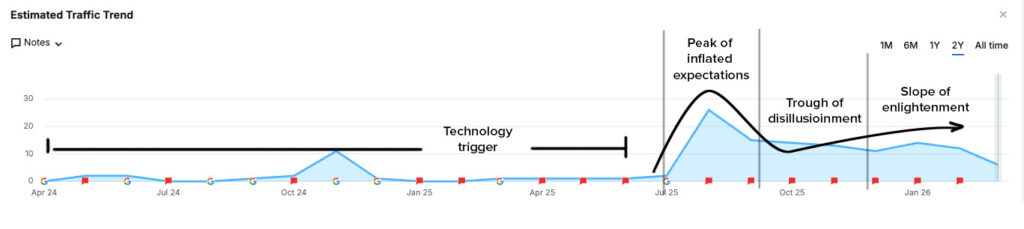
Finally, the hype stabilized into the Plateau. We updated much of the content as AI technology emerged and became a part of SASE technology (and the Hype Cycle began anew). By then, our client had established itself as an implementation partner in networking, specializing in SASE, and had a firm foundation to begin discussing the solutions it could offer in AI.
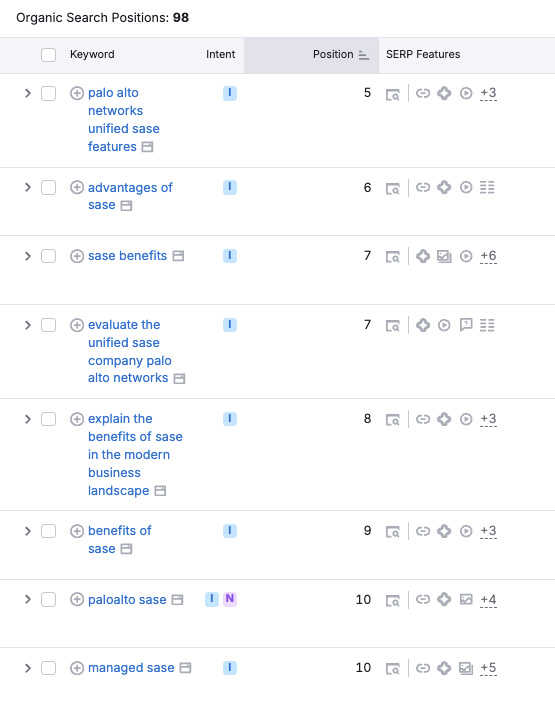
Today, that strategy has translated into measurable authority. The client now holds 98 organic keyword positions for SASE, including 8 in the top 10 and 18 in the top 20. More importantly, these rankings weren’t driven by a single spike in interest, but by consistently aligning content with each phase of the Hype Cycle—proving that long-term visibility comes from evolving with the market, not chasing it.
The hype isn’t going anywhere
The hype will keep coming: new terms, new trends, new pressure to rebrand what you already do.
The companies that win won’t be the ones who chase it. They’ll be the ones who outlast it.
Let’s build that together.