

The AI wave is here. Discover why the most successful businesses combine AI with human expertise instead of replacing strategy with automation.
I’ve been in digital and technology marketing for a long time. Long enough to have watched this industry reinvent itself — or convince itself it was reinventing itself — more times than I can count.
I was there for the dot-com boom, when every company needed a website immediately, and the money flowed fast and recklessly until it didn’t. I watched companies toss out marketing strategies to go all-in on social media, convinced that likes and follows were the new pipeline. I sat across from clients who were certain they needed an app — any app — even when they couldn’t explain what it would do or who would use it. I witnessed the shift to HTML5, which genuinely did change everything about how websites worked and quietly threatened an entire layer of the software industry that had grown up around browsers.
Every time, the pattern is the same.
New technology arrives. Panic sets in. Someone in a boardroom decides this changes everything. Budgets get redirected. Some employees are redeployed or sent packing. Vendors get realigned; some get cut. Decisions are made quickly and with confidence based on very little evidence. And the people doing the real work — the ones who understood the brand, the audience, the long game — often get caught in the undertow.
Then, slowly, the sand particles descend again to the ocean floor. The fundamentals come back. They always do.
Don’t Let AI Take the Helm.
As the AI wave continues to reshape business, here’s the thing I want to be clear about: we are not against AI. We use it every day. It has genuinely changed the pace of our work at Blue Star — research that used to take days now takes hours, pattern recognition across competitive landscapes surfaces faster, and no one stares endlessly at a blank page to begin first drafts.
We’ve deliberately and carefully built AI into our process. And yes — we have even used it in developing this article. That’s not ironic. That’s the point.
The thing is, we don’t let it take the helm. The strategic thinking, the editorial judgment, the decisions about what to say and why — that stays human. Because speed without perspective is careless and produces a ton of noise. B2B audiences, who are skeptical by nature and sophisticated by trade, can tell the difference.
Human-written content consistently outperforms AI-generated content in engagement and traffic for B2B audiences. The reason isn’t mystical. AI doesn’t know the nuances of your customers, their competitive position, or what’s worth saying.
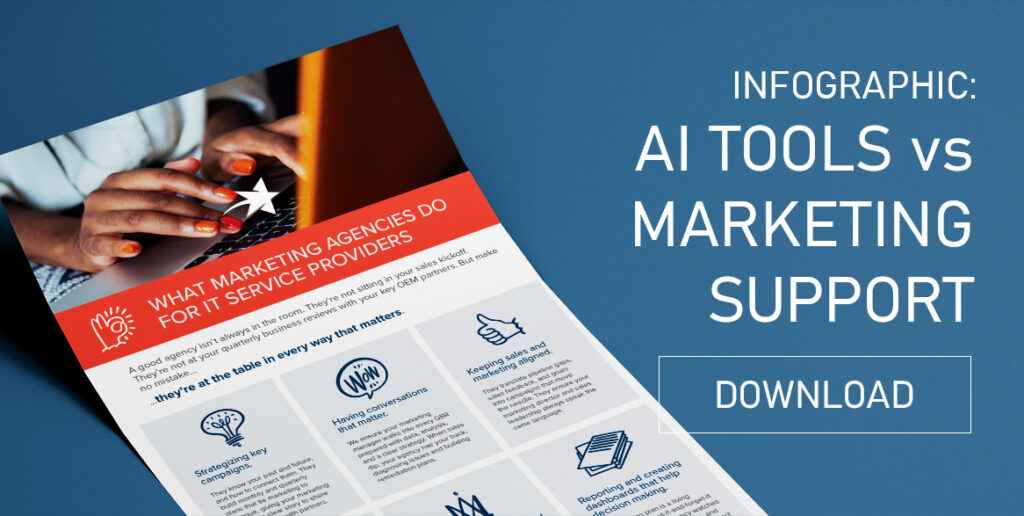
Blue Star layers AI with human expertise at every stage. We use it to speed up research and surface patterns — never to generate finished thinking. The strategy and judgment come from our team. The result: content that moves faster without losing the depth that makes it work.
AI Knows Patterns. Our Team Knows Your Business.
We know you so well that we know which one of you likes or hates the Oxford comma. We know your logo was historically designed by the founder, a hockey superfan (hence the puck-shaped logo). We know to avoid red, or green, or blue & gold because they offend your audience or carry the colors of your most-hated sports team. Heck, we even know you got a haircut
before the tradeshow because you had to take those booth photos for social media.
These are the pieces of the puzzle that help us build trust with you — and you with a specific audience, in a specific voice, within a specific competitive landscape. It’s about knowing your prospects are skeptical, technically sophisticated, and allergic to anything that feels generic. It’s knowing when a client’s biggest customer can’t be named publicly, but the story can still be told. It’s knowing you can’t use a satellite image as-is because the client will recognize the outline of their own tailings dam. That knowledge doesn’t live in a brief. It doesn’t live in a prompt. It lives in the relationship — and it takes years to build.
AI is genuinely useful, but it doesn’t wake up at 2 a.m. worried that the strategy might be slightly off. And it doesn’t take accountability when something misses.
Don’t Overcorrect.
So what do you do when you’re navigating the AI wave?
You don’t overcorrect. That’s the discipline nobody talks about. When the market lurches hard in a direction that feels wrong, every instinct says do something dramatic. Pivot hard. Reinvent. Chase whatever everyone else is chasing.
But overcorrecting into the storm is how you capsize.
The answer — the harder answer — is to keep your hands on the wheel. Assess what’s changing versus what’s just noise. Embrace the tools that make you better without abandoning the things that make you irreplaceable. Hold your position long enough for the results to come in.
Because they will come in. They always do.
The companies that went all-in on social and abandoned everything else eventually found their way back to an integrated strategy. The apps nobody needed quietly disappeared. The dot-com wreckage cleared, and the companies with real fundamentals rebuilt.
This shift will be no different. The question isn’t whether the seas are calm again. It’s whether you’re still standing — still sharp, still relevant, still you — when they do.
Also Read: Marketing Through Mergers and Acquisitions
Still Standing.
What I keep coming back to, after living through enough of these cycles, is that the fundamentals don’t disappear. They get obscured for a while by the noise of whatever the new thing is. Sure, the tools are changing. The workflows are changing. The way clients think about what they’re buying is changing. And the people doing the work — writers, designers, marketers, strategists — are being asked to shift and adopt the relevant, meaningful parts of the technology to add depth, speed, or agility.
Here’s what that sounds like in a boardroom right now: “Is this working or not?” “Are we getting the results we thought we would?” “What did we learn?” “Did we overcorrect?” “What did we find that’s worth taking forward?” “Are the results worth the investment?”
Because when it comes down to it, results matter. The ship has to find calm water and a clear direction through the waves.
I say this with the patience of someone who has watched the ocean swell, the waves crash, and, eventually, the water settles into a calm horizon.
We’re still here, together. Still navigating. Hands on the wheel.
If you’re navigating the same waters — trying to figure out what AI actually means for your marketing, your content, your team — let’s talk.