

A Thought Experiment from the Frontlines of Channel Marketing
A risky idea is spreading among IT solution providers. It sounds brilliant, efficient, even forward-thinking: “We can cut costs by letting our marketing agency go, reduce our marketing staff to one really smart and energetic coordinator, and let AI handle the rest.”
Some will even call it “forced innovation.”
You may want to pause and reconsider.
Not because AI isn’t powerful (it is). Not because cost efficiency doesn’t matter (it does). But because AI is a tool, not a strategy. And in the world of IT channel marketing, confusing the two will cost you far more than you saved.
Before making that decision, it’s essential to look beyond the immediate cost-savings and consider what the upcoming months will bring. Let us follow our hypothetical marketing coordinator to see what the next six months could actually look like if you go down that road.
Months one and two: The honeymoon
AI generates content quickly. The coordinator posts it. Things look fine on the surface. Leadership feels vindicated. The budget savings feel real.
But beneath the surface, the cracks are already forming.
Nobody is setting the overall strategy. Nobody is ensuring the content calendar aligns with your quarterly pipeline goals. Nobody is talking to your sales team about what objections they’re hearing in the field. And nobody is managing the complex web of OEM and vendor partner relationships—the ones that come with co-op and MDF dollars attached.
Months three and four: The drop-off
Campaigns that began strongly become increasingly inconsistent. The coordinator, because of volume and time constraints, executes on deliverables but can’t be strategic. AI can draft content almost instantly, but it cannot determine which campaign should take priority and why, or what it should achieve toward your quarterly and annual revenue goals. In other words, it can’t diagnose issues, and it can’t pivot.
Your brand voice starts to drift. Blog posts sound different from emails. Emails sound different from social. Creative execution loses its consistency and polish. And the timing for the release of campaign elements lacks the regular cadence it once had. Prospects, customers, and partners notice, even if they can’t articulate why. What they can articulate is that interactions or touchpoints with your company feel different, eroding the credibility and trust you’ve worked so hard to build over time.
Meanwhile, your sales team is flying blind. Marketing is not aligned with what your sales team needs. Nobody is bridging that gap because the coordinator is so busy focused on the next set of deliverables that need to go out the door. Leads, if they’re coming in at all, aren’t qualified or aren’t being nurtured in a way that helps sales close them.
How a marketing agency supports you
A reliable agency provides crucial support beyond what is visible on a timesheet.
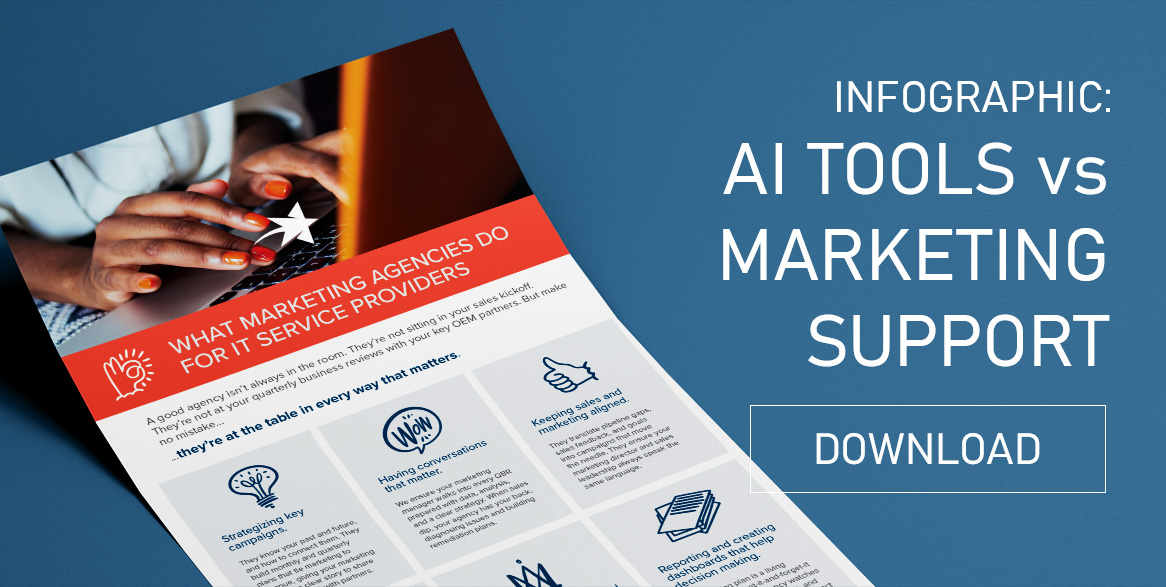
- They develop overarching strategies across campaigns.
- They create marketing materials from end to end: ideation, planning, drafting, editing, graphic design, launch, and promotion.
- They manage OEM relationships, freeing your team up to focus on higher-level strategic objectives.
- They ensure alignment between sales and marketing—all while maintaining brand consistency.
Their expertise allows your team to engage effectively in important discussions, backed by data and insights. In essence, the agency is the architecture of your marketing efforts, ensuring everything runs smoothly.
For a visual summary of these key points, check out our infographic: What Marketing Agencies Do for IT Service Providers
AI has a role—To multiply effort
None of this is an argument against AI in marketing. AI can accelerate content production, support campaign personalization, assist with research, and help a skilled marketer do more with their time. Used well, AI makes a great marketing team more effective.
But AI can’t replace strategic thinking, manage relationships, or own outcomes. It can’t sit in your QBR and explain why the pipeline is down and what needs to change. It can’t call your OEM channel manager and negotiate access to co-op funds.
The IT solution providers who win during the coming years won’t be the ones who replaced their marketing with AI. They’ll be the ones who used AI as a force multiplier within a strategy-led marketing program—one with the human expertise, partner relationships, and accountability structures to deliver results.
When you pair AI-powered tools with an experienced an AI-savvy agency, that force multiplier increases exponentially.
A word to IT solution provider leadership
Before you decide to reduce your marketing team to a single coordinator or try to replace your agency with AI, ask yourself four questions:
1. Who will own the strategy?
Not the execution — the strategy. The plan that connects marketing activity to the pipeline to revenue, and evolves as the business does.
2. Who will prepare your marketer for the conversations that count?
Your marketing director needs to walk into sales kickoffs, partner QBRs, and internal business meetings armed with data, a straightforward narrative, and a credible plan. Who is building that for them?
3. Who will manage your OEM and partner MDF relationships behind the scenes?
And who will ensure you’re capturing every dollar you’re entitled to and that your marketer can defend that spend to your partners with confidence?
4. Who will monitor the data and let you know when something needs to change?
When a campaign underperforms in month two, or when a region is lagging on pipeline, who diagnoses the marketing side of that problem and builds the plan to fix it, in alignment with sales?
If you can answer those questions confidently, then perhaps a leaner model can work. But if the honest answer is “AI and one coordinator will figure it out,” you’re not cutting costs. You’re borrowing against your future revenue—and the bill comes due faster than you think.
AI is a tool. Strategy is the work. Don’t confuse the two.
Blue Star Design has been working closely with IT service providers for nearly three decades. AI is far from our first technological revolution.
Ready to work with a team that understands both AI and strategy?