

A case study in technical marketing, brand evolution, and audience growth.
Blue Star’s whole thing is helping organizations explain complicated ideas without losing people. We’ve worked with healthcare systems, tech companies, manufacturers, engineers—and no matter who it is, we start the same way: learn the business well enough to actually tell the story right.
With PhotoSat, that meant getting comfortable in a world of satellite monitoring, geospatial intelligence, mining operations, and exploration geology. It also meant earning the trust of some of the most technically sharp audiences we’ve ever worked with.
The Learning Curve
We didn’t fake it. Early on, our team genuinely immersed itself in PhotoSat’s world—the language, the technology, and how the work is used in the field.
We learned why accuracy and resolution aren’t the same thing (they really aren’t). We figured out what InSAR actually does and why mining engineers care about it. We got into hyperspectral imaging and how it helps geologists make exploration decisions. We read technical guides, dug through case studies, sat with alteration reports and conference papers—not to sound smart, but because you can’t write about something you don’t understand.
Our team genuinely immersed itself in PhotoSat’s world—the language, the technology, and how the work is used in the field. We spent time with PhotoSat’s team, participated in product discussions, reviewed internal training materials, and watched technical training videos to understand the technology the way their experts do.
Every project was part education, part execution. That investment paid off. The deeper our understanding got, the better our work got.
Elevating the Brand
Knowing the technology was only half the job.
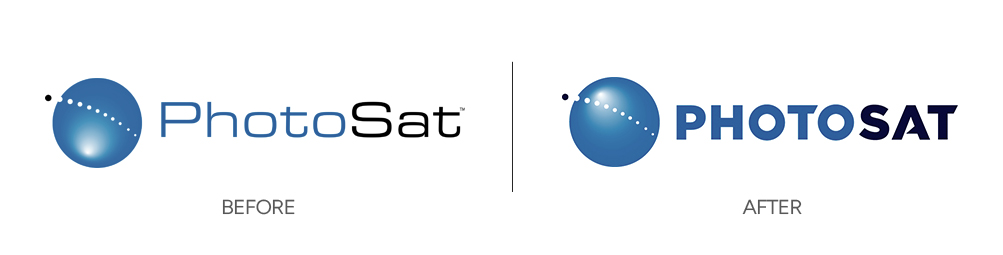
PhotoSat delivers sophisticated satellite monitoring and geospatial intelligence to mining organizations around the world—but as the company has grown, its brand presence wasn’t quite keeping pace with the quality of its work.
So we refreshed things. Not a rebrand—more of a tightening. We updated brand standards, redesigned presentation systems, built out collateral, and standardized social media graphics and supporting assets. The goal was simple: make sure that every time someone encountered PhotoSat—at a booth, in a deck, on LinkedIn—it looked and felt like a company that knew what it was doing.
Because it did.
Turning Technical Expertise Into Marketing
A lot of PhotoSat’s most powerful technology was also its hardest to explain. The engineering was rigorous, the terminology dense, and for many mining professionals—whether they were unfamiliar with satellite monitoring or simply skeptical of adopting new services—the barrier wasn’t interest. It was access.
Our job was to lower that barrier. We took heavy engineering language and turned it into infographics and ebooks that could be picked up and understood by someone encountering these technologies for the first time. Clear visuals. Plain language. No dumbing down—just better translation.
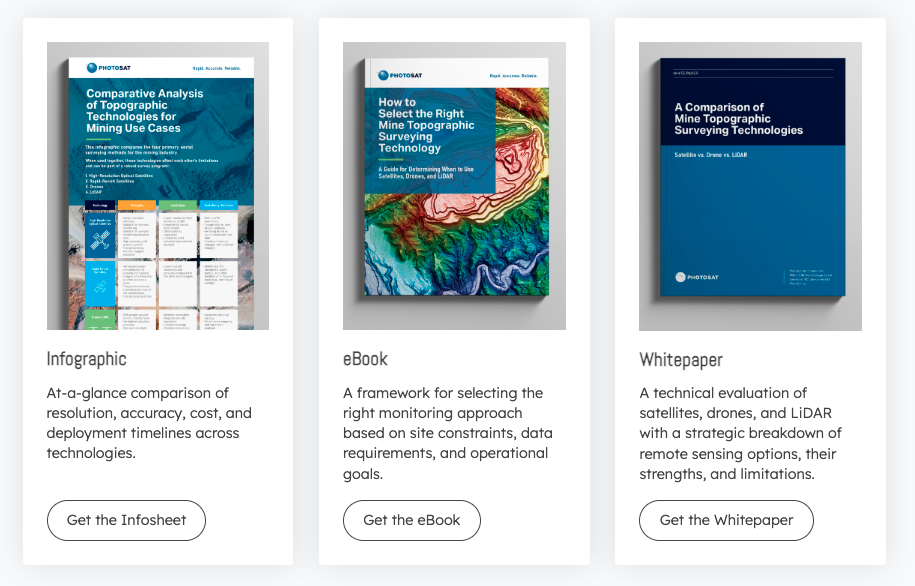
That’s harder than it sounds. You have to understand the technical material well enough to simplify it without getting anything wrong—and respect your audience enough not to talk down to them.
Over time, we became a real extension of PhotoSat’s marketing function—a team that understood the work and could run with it.
79 projects. 1,000+ hours. Campaigns, content, conference marketing, social media, design, brand systems.
That included:
- Integrated marketing campaigns in English and Spanish markets
- Whitepapers, ebooks, technical blogs, and conference abstracts
- 10 months of LinkedIn content strategy and execution
- Conference materials for subject matter experts, the Prospectors & Developers Association, and the Association for Mineral Exploration
- Technical infographics and educational graphics that made complex technology accessible to mining professionals at every level
- Tone-of-voice documentation, landing pages, and campaign support
Growing PhotoSat’s Social Presence
Creating technical content was only part of the engagement. Getting that content in front of the right audience was equally important.
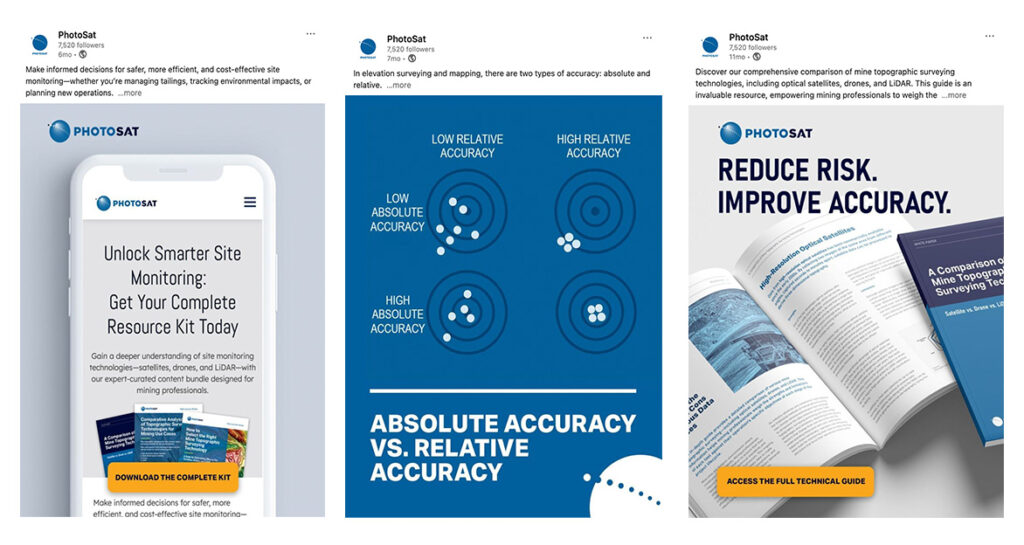
Blue Star assumed management of PhotoSat’s social media program in June 2025, building on the company’s existing presence with a more consistent content strategy, campaign execution, and the introduction of paid social advertising.
The results over the remainder of the year demonstrated meaningful growth in both reach and engagement.
Social Performance (January–May vs. June–December 2025)
| Metric | Jan–May (Pre-Blue Star) | Jun–Dec (Blue Star) |
| Average Monthly Organic Impressions | 3,562 | 4,432 (+24%) |
| Average Monthly Organic Engagement | 327 | 425 (+30%) |
| Organic Engagement Rate | 9.17% | 9.58% |
| Paid Social Program | None | 291,804 average monthly impressions |
| Average Monthly Paid Engagements | None | 2,467 |
| Average Cost Per Click | N/A | CA$0.18 |
In addition, website traffic driven from paid social increased substantially during the engagement period as Blue Star launched and optimized PhotoSat’s first sustained paid social campaigns.
Combined with technical content development, campaign strategy, and consistent social publishing, these efforts helped expand PhotoSat’s visibility within the mining and geospatial industries while maintaining strong engagement with a highly specialized audience.
Building More Than Content
The honest truth is that the most valuable thing we built wasn’t a campaign, a whitepaper, or a social media program. It was understanding.
By the end of the engagement, our team had developed real working fluency in PhotoSat’s technologies, audiences, and markets. We understood how geologists evaluate exploration opportunities, how engineers approach monitoring and risk, and how mining organizations make decisions about adopting new technologies.
That depth of knowledge changed everything.
It influenced every campaign, every asset, every infographic, every LinkedIn post, every design decision, and every conversation about how to position PhotoSat’s capabilities in the market. Instead of simply producing marketing materials, we became a strategic extension of the marketing team—bringing context, consistency, and technical credibility to every project.
That’s difficult to measure on a spreadsheet, but it’s what made the work more effective.
What the Data Showed
Before Blue Star’s engagement, PhotoSat had solid visibility, but its marketing efforts were largely campaign-by-campaign. Website traffic arrived in bursts, social activity was modest, and there was an opportunity to create a more connected marketing ecosystem.
During 2025, that ecosystem began to take shape.
Website sessions increased from 19,093 to 41,343—a 116% year-over-year increase—while users grew from approximately 14,000 to 31,000. Paid Social sessions increased from roughly 7,100 to 25,000, and Direct traffic nearly doubled from 5,500 to 11,000.
Social media performance strengthened during Blue Star’s management. Average monthly organic impressions increased 24%, engagements grew 30%, and engagement rate improved from 9.17% to 9.58%. Blue Star also launched PhotoSat’s first sustained paid social program, generating an average of 291,804 monthly impressions with an average cost per click of just CA$0.18.
The most important change wasn’t any single metric—it was how the marketing worked together. Brand, content, campaigns, and social media became part of one coordinated strategy rather than a series of independent activities.
2024 generated attention.
2025 built a marketing system designed to sustain it
Blue Star Design became a trusted partner and extension to my small marketing team. Their execution is consistently strong, supported by excellent project management and timely, dependable delivery. They quickly took time to research and understand our unique business, allowing us to move to execution with minimal friction, and are consistently there when and how my team needs them.
– Camille Krupa, Marketing
Looking Back
Technical marketing gets called “content creation” a lot. After this engagement, that framing feels too small.
The work that actually mattered started with curiosity—asking real questions, listening carefully, taking the time to understand an industry before saying anything about it. And then doing the harder thing: making that industry understandable to the people inside it who needed clearer answers.
That’s what a technical marketing agency actually does. Not just translating complexity for outsiders—but making sure the right people, at the right moment, can see why a technology matters and what it can do for them.
Working with PhotoSat gave us the chance to do that at a high level, with a technically demanding audience, over a long enough period that the understanding really accumulated.
We’re proud of the work we created. We’re even prouder that we earned the ability to create it.